
A research team at the Wadsworth Center has developed an innovative, environmentally friendly method for extracting trace metals from biological samples without the use of concentrated mineral acids. Led by Dr. George Donati, Deputy Director of the Laboratory of Inorganic and Nuclear Chemistry, the study demonstrates a safer, greener alternative to conventional digestion techniques used in environmental, toxicological, and food safety testing.
Co-authored by Professor Jemmyson de Jesus (Federal University of Viçosa, Brazil) and Dr. Karl Yang (Research Scientist in the Laboratory of Inorganic and Nuclear Chemistry), the work was published in the Microchemical Journal on November 7, 2025, and describes how ultrasound energy combined with hydrogen peroxide can release trace metals from plant and animal tissues efficiently and cleanly, generating oxygen and water as byproducts. Traditional metal extraction methods rely on microwave digestion using concentrated nitric acid – effective but energy-intensive and that produces hazardous chemical waste. In contrast, the Wadsworth Center’s approach uses the principles of “green” analytical chemistry, offering comparable performance with less environmental impact.
Dr. Donati and colleagues note in the publication: “The acid-free sonochemical extraction method is a viable, sustainable alternative for trace element determination in biological matrices, offering performance comparable to conventional digestion strategies, with reduced environmental impact … offering a promising route for future applications in environmental monitoring and food safety.”
Key Advantages of the Acid-Free Extraction Method:
- No concentrated mineral acids required: reduces hazardous waste generation, improves analyst safety, and minimizes environmental impact.
- Energy-efficient conditions: uses a simple ultrasonic bath and 25% v/v hydrogen peroxide at 60°C, far lower than the 180–210°C typical of microwave-assisted digestion.
- Good extraction efficiency: achieves 81–110% recoveries for key metals (Cu, Fe, Zn) from biological matrices such as fish tissue.
- Parts-per-billion capabilities: enables accurate quantification of essential metals at the trace level.
- Scalable and sample-efficient: applicable to sample sizes as small as 20 mg, with performance comparable to traditional methods.
Reference: J.R. de Jesus, K.X. Yang, G.L. Donati. Green sample preparation method based on acid-free sonochemical extraction for trace element determination in biological samples, Microchemical Journal, 219 (2025) 116116. https://doi.org/10.1016/j.microc.2025.116116.
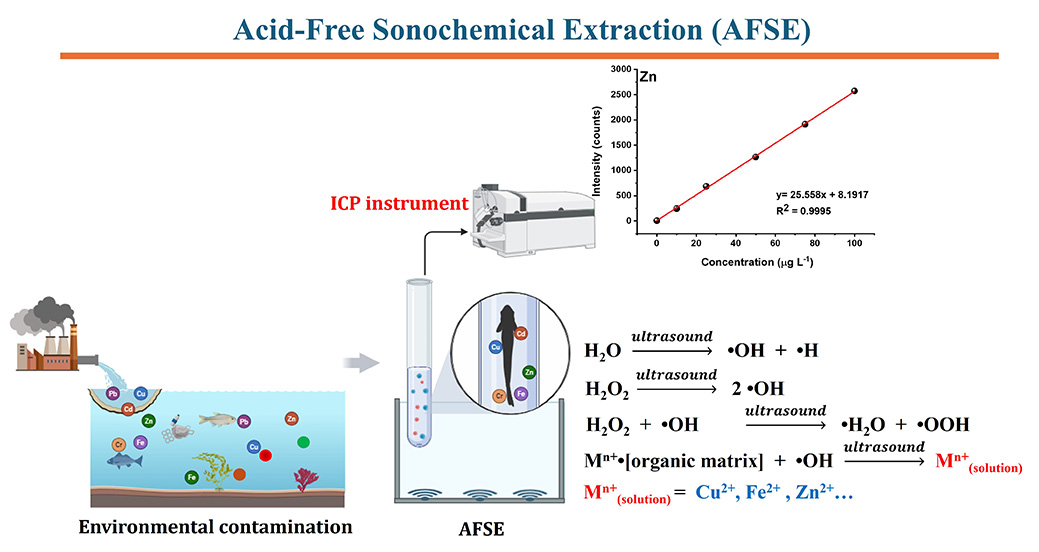
Metal extraction from fish tissue employing microwave radiation and hydrogen peroxide. Reactive species such as OH, H, and OOH radicals facilitate the extraction process. Essential metals, such as copper, iron and zinc, are effectively extracted and quantified.